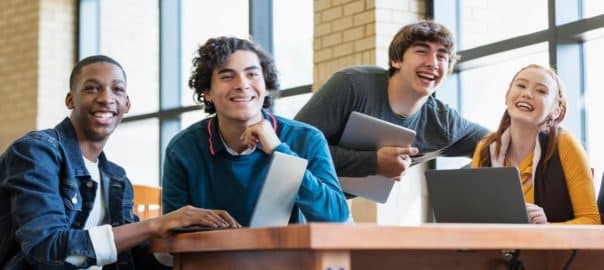
Simulation-based learning has become increasingly common in secondary education, particularly in subjects like business studies, economics, and STEM. Rather than relying solely on textbooks and lectures, business simulations place students in interactive, decision-driven environments where they must apply knowledge in realistic scenarios.
But beyond engagement, what does the research actually say?
1. Simulations significantly improve learning outcomes
Research in higher education and secondary contexts shows that simulation-based learning has a consistently positive impact on student performance.
A major meta-analysis of 145 studies found that simulations produce a strong overall effect on learning achievement across disciplines, including business and teacher education.
This suggests simulations are not just more engaging, they are measurably more effective than many traditional teaching methods for developing complex skills.
2. Students develop stronger problem-solving and decision-making skills
Research comparing simulations with lectures and case studies shows that students using simulations demonstrate:
- Better problem-solving ability
- Improved interpersonal and collaboration skills
- Higher levels of self-awareness in decision-making
In business education specifically, simulations are often rated by students as the most effective learning method compared to lectures and case studies.
The key difference is active participation: students are not just learning concepts, they are using them under realistic constraints.
3. Simulations support “learning by doing” which improves retention
One of the strongest findings across simulation research is that experiential learning improves knowledge retention.
Instead of passively absorbing information, students:
- Make decisions
- See consequences immediately
- Adjust strategies over time
This feedback loop strengthens conceptual understanding, especially in abstract topics like pricing, supply and demand, and financial planning.
Business simulation research consistently highlights improved motivation and engagement because students feel responsible for outcomes rather than memorizing theory.
4. Simulations are effective across different learner abilities
Research also shows simulations are flexible across student ability levels when properly supported.
- Lower prior-knowledge students benefit from structured guidance and examples
- Higher prior-knowledge students benefit more from reflection and open-ended scenarios
This means simulations can be adapted for mixed-ability classrooms, which is especially important in secondary education environments.
5. Collaboration and communication skills improve naturally
Many simulations require students to work in teams, take on roles (e.g. CEO, marketing manager, CFO), and negotiate decisions.
This creates opportunities for:
- Structured collaboration
- Peer discussion and argumentation
- Real-time negotiation and compromise
These skills that are difficult to teach through traditional methods but emerge naturally in simulation environments.
6. Simulations bridge the gap between theory and real-world application
One of the most important contributions of simulation-based learning is contextualization.
Students often struggle with abstract economic or business concepts until they see them applied. Simulations help bridge that gap by creating environments that mimic real market conditions and business pressures.
This aligns with a broader finding across education research: students learn more effectively when theory is connected to authentic decision-making contexts.
7. Limitations identified in research
While the evidence is strongly positive, research also highlights important caveats:
- Poorly designed simulations can reduce learning value
- Overly complex systems can overwhelm beginners
- Teacher facilitation (especially debriefing) is critical
- Learning gains depend heavily on instructional design, not just the tool itself
In other words, simulations are not automatically effective, they are effective when well-integrated into teaching practice.
The research is clear: simulation-based learning is one of the most-effective approaches for teaching complex, applied subjects in secondary education.
When implemented well, simulations:
- Improve learning outcomes
- Increase engagement and motivation
- Develop critical 21st-century skills
- Help students connect theory with real-world application
However, their success depends on thoughtful design, appropriate scaffolding, and strong teacher facilitation.
For high schools looking to improve engagement while strengthening real-world skill development, business simulations offers a proven, research-backed approach worth serious consideration.
Bring simulation-based learning to your school. Request a free demo or contact our team to explore how it fits your classroom or curriculum.