Category Archives: News

Picture of Dr. Robert Sproule

Desire2Learn Innovation Award

Bob Sproule of the University of Waterloo, a long time user of our MikesBikes-Intro Simulation, has been awarded the Desire2Learn Innovation Award. The award seeks to recognize and celebrate innovative teaching approaches in post-secondary education worldwide.

Bob has received this award for his exceptional and innovative approach to education through his integration of MikesBikes into his Introduction to Business Course, and complimentary course content. Students are placed into teams of four to manage their MikesBikes company, where  they develop company strategy and implement this through our online interface.

Desire2Learn Incorporated is a world-leading provider of enterprise eLearning solutions that enable institutions and other organizations to create teaching and learning environments that reflect their vision, goals, and branding. Desire2Learn and its subsidiaries support more than eight million learners worldwide.

Another of our long-time Instructors, Darl Kolb, received the DEANZ award for Collaborating accross Distance, Functions and Institutional Boundaries.

Darl, of the University of Auckland, teamed up with Bill Smith, of the Eastern Institute of Technology, to run an inter-institutional learning experience over a 10 week period using MikesBikes-Advanced, where students from each institution competed against one another using the Simulation. The project promoted student participation, interaction and teamwork, and was a large success.

The proven experiential learning students are exposed to by using MikesBikes, is a large contributing factor to the success of these courses.

Drexel Logo

2012 Business Teaching Summit at Drexel University

The LeBow College of Business Center for Teaching Excellence will be holding the 2nd annual Business Professor Teaching Summit (BPTS) at Drexel University on Friday, May 18, 2012.

The BPTS is a business school faculty conference dedicated to sharing innovative and effective strategies to enhance student learning across all business disciplines. The Summit will include speakers from  learning institutions, as well as several key guest speakers from successful businesses and corporations.

Jodi Cataline, a long-time user of our MikesBikes-Intro Business Simulation will be speaking alongside Dennis Gain, Smartsims’ CEO, on the effectiveness of Experiential Learning in the classroom through the use of simulation. Jodi and Dennis’ presentation will include how MikesBikes can be integrated into a course, and the support that Smartsims offer throughout the course. MikesBikes has been proven to accelerate learning by reinforcing foundational business principles as students gain hands-on experience in the classroom.

MikesBikes-Intro is our introduction to business simulation. Students are progressively given control over their own company, where they compete against other student teams in their course for control of the market

If you wish to attend the conference, please register here:http://www.lebow.drexel.edu/Faculty/Centers/BPTS/index.php


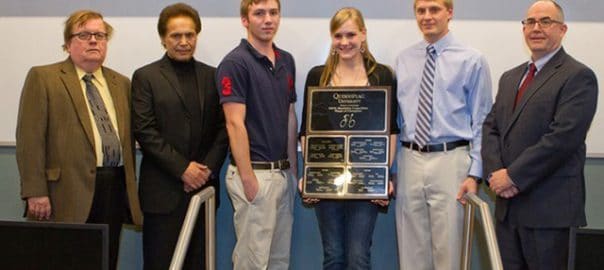
Photo of Quinnipiac Competition Winners

Quinnipiac Winners

David Cadden a Cheshire resident and professor of management at Quinnipiac University, led a team of four business students to victory in this year’s MikesBikes-Intro simulation.

SWAG Cycles, a team comprised of School of Business students Matthew Golden of Walpole, Mass., Malgorzata Kielbowicz of New Britain, Spencer Mannion of Brookfield and Alison Scharr of East Granby, were honored Nov. 28 for beating 75 Quinnipiac teams participating.

Each fall, all incoming freshmen in the School of Business take the course Introduction to Business, which relies heavily on the MikesBikes business simulation software to reinforce business concepts in an experiential learning environment.

Student teams make business decisions for their simulated bike manufacturing company that get progressively more complicated throughout the semester. By the end of the simulation, student teams decide everything from marketing strategies to launching new products, manufacturing capacity, quality control and financing decisions.

Student team performance in the MikesBikes simulation is measured by the resulting shareholder value created by their company. Each year, the winners’ names are engraved on a plaque that hangs outside the dean’s office in the Lender School of Business Center.

The winning team had the highest shareholder value among the Quinnipiac teams competing. In addition, Golden, Kielbowicz, Mannion and Scharr placed 38th overall from a field of more than 6,500 teams from universities around the world.

Dennis Gain, CEO of Smartsims, the company that created the MikesBikes simulation software, visited Quinnipiac to help Matthew O’Connor, dean of the School of Business, present the plaque to the winning team.

Source: http://cheshire.patch.com/articles/qu-students-led-by-cheshire-professor-win-business-competition

2010 National Business Olympiad

Smartsims India (iInteract) conducted Simulations across India this year as part of their National Business Olympiad.

National Business Olympiad is a business simulation competition using MikesBikes-Advanced, conducted specially for management students with an intention to test their strategic frame of mind and conceptual skills in Finance, Human Resource, Marketing, Operations and R&D.

This event was conducted across 17 major cities, with the grand finale held at the Indian Institute of Management (IIM) in Ahemedabad on 26th – 28th November, 2010 during their 50th year celebration flagship summit Confluence 2010.

Confluence 2010 is the second largest Business School festival behind IIM Calcutta’s Intaglio. Over the years, Confluence has attracted participation from business schools across India as well as abroad. It hosts events from all the standard arenas of Management – Finance, Marketing, Strategy, Entrepreneurship and IT and Operations. Many distinguished speakers and industry leaders share their knowledge, and the event provides a platform to budding managers to apply their skills in various games and events organized during the meet, including the MikesBikes competition. 

There were around 72 teams in the finals of the event at Confluence 2010. In addition to Business Schools, a few corporate house teams also participated in the event.

Students from Ahmedabad based “Entrepreneurship Development Institute of India” took all the 3 positions in the finals, making it a clean sweep.

The team of Ankur Joshi, Pawan Kumari and Anshul Goel showed their managerial skills and acumen to emerge as winners. The first runners up and the second runners up were the teams from FMS, Dhaula Kuan, Delhi and IMS – Noida respectively.

Dr. Kiran Bedi, Former IPS Officer was the Chief Guest at the award presentation ceremony and she presented certificates to the winning team members. The award also consists of a cash prize of Rs 1,00,000.

Some of the notable among the registered participating colleges were FMS, IIFT, Jaypee Business School, FMS – Rural Management Institute (Jaipur), EMPI, IMS – Noida, Galgotia Business School, IITM, Technia.

MikesBikes-Advanced is a Strategic Management Simulation by Smartsims Business Simulations. MikesBikes gives students the unique opportunity of running their own company, while competing against other students, within a realistic and dynamic environment.

Students form the management team of their own Bicycle Manufacturing Company, making all the key functional decisions. They will analyze real Market and Financial reports, and collaborate with each other to formulate, implement, and review their own cross-functional strategic plan.

Experiential Learning & Music2Go Marketing

Experiential Learning is a highly effective educational tool, and a key feature that sets our Simulations apart from other teaching methods.

Experiential Learning focuses on the learning process for the individual, through observation and interaction with the subject they are learning about rather than the traditional process of learning from a textbook.

Katie Matthew recently spoke at the Annual Conference of the Society for Marketing Advances in Memphis, Tennessee about her integration of ourMusic2Go Marketing Simulation in her Introductory Marketing Course, and how this has added value by bringing Experiential Learning to her classroom. Katie is a Major in the U.S. Army and Instructor at The United States Military Academy at West Point.

Some of the key benefits of Music2Go that she mentioned included the following:

  • Encouraged more student engagement/involvement;
  • Produced better learning outcomes;
  • Students indicated they preferred this style of learning;
  •  Better prepared students to make real-world decisions.

Katie fully embraced the Experiential Learning process by having Music2Go as the “Major Event” for her course. She notes that the “time tested and proven” nature of the Music2Go software, which included teaching resources and 24 hour support played a big part in adopting the Simulation. Another feature she mentions that is typical with Experiential Learning is the immediate feedback students receive on their decisions, which enables them to see what works and what doesn’t. Whether or not decisions are optimal, the results give students a clear and immediate insight into the linkages between functional decision areas – something not possible with traditional learning methods.

“It helped us apply what we learned in class; to see the how wrong or how right we were in making decisions. This experience can’t be replaced except by real life.”

From an educator’s point of view, Katie enjoys the flexibility that Music2Go gives her, with adjustable timelines that can change with course needs, and the ability to easily monitor student performance. She has adopted a “Consultant” role to students, giving teams the option of approaching her for guidance on certain decision areas, and is able to deduct a virtual “fee” from their Marketing Budget within the simulation. This further enhances the real-world feel that the Simulation brings to the classroom, while encouraging participation.

“I enjoyed it so much more because of the competitive aspect it offered. I also learned more because it is a nice change of pace to move away from the books and to see what we would be doing if we actually were in marketing as a profession.”

To be truly effective, Experiential Learning needs to incorporate the entire learning wheel – from goal setting, to experimenting and observing, to reviewing, and finally action planning. The complete process allows students to learn new skills, new attitudes and entirely new ways of thinking.

To see how you can bring Experiential Learning to your classroom via our Music2Go Marketing Simulation, or any of our other simulations, feel free to contact the Smartsims Sales Team at sales@smartsims.com


Credit to Katie Matthew, Bill Madway, and the Society for Marketing Advances – see below links for full SMA publications.

SMA Teacher-Friendly Experiential Learning Projects

Experiential Learning Projects Reference Guide for Marketing Educators

Presentation on Active Learning at the 2011 Marketing Management Association’s Fall Educators’ Conference

Teacher-Friendly Options for Incorporating Experiential Learning Projects in Marketing Courses

Strategic Approaches to Active Learning

Smartsims Feature at the Annual SMA Conference

The Society for Marketing Advances (SMA) held their annual conference during the first week of November 2011, bringing together marketing educators from throughout the United States and abroad.

Lecturer William M. Madway of The Wharton School at the University of Pennsylvania co-chaired the Marketing Education track, putting together a discussion panel called “Teacher Friendly Options for Incorporating Experiential Learning Projects in Marketing Courses”. Bill brings over 20 years of experience in the marketing profession to the classroom. He has used various experiential learning projects in his marketing classes, including our Music2Go Marketing Simulation and the National Student Advertising Competition.

He was joined by Professor Katie Matthew, a Major in the U.S. Army and Instructor at the United States Military Academy at West Point. Katie teaches courses in marketing and military leadership for the Department of Behavioral Sciences & Leadership and also uses our Music2Go Marketing Simulation.

Other educators who shared their experience on the panel include Leslie Kendrick from John Hopkins University & Whiting School of Engineering’s Center for Leadership Education; Marilyn Lavin from University of Wisconsin – Whitewater; and Sandy Utt from University of Memphis.

The session was designed to familiarize marketing educators with effective experiential learning projects that are relatively easy to implement. The session recognized that while educators identified the advantages of experiential learning, and even students tend to prefer active, real-world teching techniques, challenges exist that hinder greater use of these methods.

Below is an excerpt from the Conference Guide regarding this issue:

One major impediment is the amount of time involved in designing and carrying out experiential learning activities, especially real-world class projects. Instructors often must find a company willing to serve as a “client,” and must then manage this relationship. These projects also require instructors to provide a great deal of support for students outside the classroom. What’s more, it can be difficult to assess individual student learning and performance, as many of these projects are carried out by teams. Online simulations eliminate the need to find clients, but still require considerable advising time, not to mention the time needed to address the inevitable technical problems.”

Fortunately, a number of experiential learning options that overcome these challenges are now available for use in a wide variety of marketing courses, ranging from Introduction to Marketing to capstone courses such as Marketing Strategy and Advertising Campaigns. Many of these options involve “live” cases, developed in cooperation with major multinational companies, in which students conduct primary research, develop recommendations, and present their findings to the client company. Multiple universities can simultaneously utilize the cases, which usually include a competitive aspect, i.e., teams at participating schools compete against one another for recognition, and in some cases, prizes. Some of these projects allow students to actually implement their recommendations, with funding provided by the sponsoring company”.


The SMA session focused on four experential learning projects which panelists identified as being among the best available and providing a benchmark against which other options could and should be measured:

The Music2Go Marketing Simulation. A highly realistic,  comprehensive online marketing simulation developed by Smartsims. Students take over the MP3 player division of a large consumer electronics company, and formulate segmentation, positioning, sales, distribution, pricing, new product development, and promotion strategies, as they attempt to build their firm into the leading player in the market. Student teams compete against other teams within their course.

The Marketing Internship Program (MI), one of two types of industry-education collaborative programs created by EdVenture Partners. In the MI program, students taking a for-credit, marketing or advertising class research the target audience; create a marketing campaign, which they pitch to their client for approval; and implement their plan using funds provided by their client. Students also analyze their results and present their findings to their client. Organizations participating in the MI program in recent years include Chevrolet,
Nissan, Sapphire Mobile Systems the FBI, and the U.S. Navy.

The Google Online Marketing Challenge. Student teams receive $200 of Google advertising, and work with local companies or NGOs to create online marketing campaigns. The challenge is open to colleges around the world. Regional winners and their professor receive a trip to a regional Google office; the global winners and their professor receive a trip to Google’s world headquarters.

 The American Advertising Federation’s National Student Advertising Competition. Student teams develop an integrated communications campaign to address a real-world marketing problem facing the sponsoring company or non-profit, and “pitch” it to a panel of judges in regional competitions. The top team in each region advances to the national finals. Recent NSAC sponsors include AOL, Coca-Cola, Florida Tourism, J.C. Penney, and State Farm Insurance.


The panel also discussed the integration of the above projects into syllabi, the instructors’ roles, the provision of resources and assistance in overcoming likely challenges. Performance evaluation, participant reflection and the impact of competitive elements in the projects were also discussed.

Below are some publications courtesy of William M. Madway:

Presentation at 2011 Society for Marketing Advances Conference on Teacher-Friendly Experiential Learning Projects

Teacher-Friendly Experiential Learning Projects Reference Guide for Marketing Educators

Presentation on Active Learning at the 2011 Marketing Management Association’s Fall Educators’ Conference

Smartsims are proud to be recognised at the SMA, which discussed the Segmentation Options of the simulation in great detail covering Market Demographics, Products, Pricing, Distribution and Promotion. Panelists discussed how one of the simulation’s greatest value adding feature was recognizing and catering to Consumer Preferences across various unique and emerging market segments. We hope to continue contributing positively to the Marketing Educational System throughout the world.

– Danny Master

The Modern Classroom & Smartsims

“K-12 education isn’t using technology effectively and isn’t investing nearly enough in IT infrastructures to enable next-generation learning”

That’s the conclusion of a new report, ‘Unleashing the Potential of Technology in Education’, which called for greater financial commitment to educational technology in our schools.¹ By not focusing more on boosting student outcomes with online technology, traditional educational practices may end up leaving a vast gap in the coming generations’ capabilities.

A 2011 XpertHR learning and development survey announced that using online computer training improves skills at considerably greater rate than traditional methods.² This makes online learning an indispensable educational tool.

The good news is that once students reach College/University, they are being given the opportunity to experience online technologies as business schools across the board have been increasing their use of online learning. The economic downturn is also increasing demand for online courses. As of April 2011, 60% of private sector colleges and universities reported that online education is critical to their long-term strategies.³ This can be attributed to online student enrollments continuing to be the most rapidly growing sector in higher education.

This transition to online learning has opened new teaching methods previously unavailable to Instructors. Experiential learning, like that of simulations, allows students to translate theory into practice. Simulations help students retain far more information than traditional teaching methodologies, as they become immersed in the experience of the concepts being taught, rather than only reading or hearing about them.

From an Instructor’s perspective, using a business simulation allows them to come alongside their students to direct their learning, rather than simply talking at their students. This also gives students a sense of ownership over what they learn, and the experience itself will remain in their memories long-term. In fact, we have past-students contact us on a regular basis to request our simulations be used in their new workplace, or even at the school they now teach at, as it was the highlight of their degree and something they now want their colleagues or students to experience.

Smartsims have a reputation for high quality simulations and world-class customer service; something we’ve developed over our 20 years of industry experience. Students are taught the fundamental concepts of business and strategy directly through business simulation. Students also learn important real-world skills such as working within a team, situational analysis, how to read real financial and market reports, and the formulation of strategy based on their findings. Our business simulations are extremely flexible and can be integrated into a wide variety of on-campus and online courses.

– Danny Master and Ian McPherson

[1] The Journal. (2011, August 9), Closing the Loop in Education Technology, http://thejournal.com/Articles/2011/08/09/Closing-the-Loop-in-Education-Technology.aspx?Page=2.

[2] Computeach, (2011, May 10), Computer Training: Learning Online ‘Rising’, http://www.computeach.co.uk/IT-news/IT-Computer-Technology-News/Computer-training-Learning-online-rising/800523443.

[3] The Examiner (2011, April 18), Economy Sparks Rising Demand for Online College Courses, http://www.examiner.com/online-learning-in-washington-dc/new-study-asserts-bad-economy-means-more-demand-for-online-courses.

Music2Go Marketing Simulation at USMA – West Point

Katie Matthew is a Major in the United States Army and Course Instructor at The United States Military Academy at West Point. Katie uses our Music2Go Marketing Simulation in her Introductory Marketing Course. At a 2011 Society for Marketing Advances Annual Conference, Katie spoke about her integration of Music2Go Marketing into her course, and how this has added value by bringing Experiential Learning to her classroom.

Some of the key benefits of Music2Go that she mentioned included the following:

  • Encouraged more student engagement/involvement;
  • Produced better learning outcomes;
  • Students indicated they preferred this style of learning;
  • Better prepared students to make real-world decisions.

Katie fully embraced the Experiential Learning process by having Music2Go as the “Major Event” for her course. She notes that the “time tested and proven” nature of the Music2Go software, which included teaching resources and 24 hour support played a big part in adopting the Simulation. Another feature she mentions that is typical with Experiential Learning is the immediate feedback students receive on their decisions, which enables them to see what works and what doesn’t. Whether or not decisions are optimal, the results give students a clear and immediate insight into the linkages between functional decision areas – something not possible with traditional learning methods.

“It helped us apply what we learned in class; to see the how wrong or how right we were in making decisions. This experience can’t be replaced except by real life.”

From an educator’s point of view, Katie enjoys the flexibility that Music2Go gives her, with adjustable timelines that can change with course needs, and the ability to easily monitor student performance. She has adopted a “Consultant” role to students, giving teams the option of approaching her for guidance on certain decision areas, and is able to deduct a virtual “fee” from their Marketing Budget within the simulation. This further enhances the real-world feel that the Simulation brings to the classroom, while encouraging participation.

“I enjoyed it so much more because of the competitive aspect it offered. I also learned more because it is a nice change of pace to move away from the books and to see what we would be doing if we actually were in marketing as a profession.”

To be truly effective, Experiential Learning needs to incorporate the entire learning wheel – from goal setting, to experimenting and observing, to reviewing, and finally action planning. The complete process allows students to learn new skills, new attitudes and entirely new ways of thinking.

Credit: to Katie Matthew (USMA), Bill Madway (The Wharton School) and the Society for Marketing Advances.

Using Simulations for Seminars, Corporate Training and Team Building

Smartsims Business Simulations have been used within Corporate Training, Business Seminars and Team Building exercises globally for many years.

Today, close to 70% of corporations are using Business Simulations as part of their repertoire of training methodologies to educate their management and staff at all levels. One of the many reasons for this is that experiential learning programs have very high information retention rates amongst participants. A study in the Training and Development Journal, stated: ” People retain about 25% of what they hear, 45% of what they see and hear, and 70% of what they see, hear and do.

The following are just a few organisations that have taken their Corporate Training to the next level using our state of the art Business Simulations.

MAHLE Industries, have been using our MikesBikes-Advanced Strategic Management Simulation in recent years as part of their Management Development program. Ralf Roeske, Senior Director of Finance, chose the MikesBikes-Advanced Business Simulation as it tied in all of the functional areas of a business, and encouraged a better understanding of how these functions are important in the efficient running of a company as a whole. Through experiential learning, MikesBikes-Advanced provides participants with the unique opportunity to evaluate, plan, and implement strategy as they manage their own company.

MAHLE are the worldwide leader in automotive parts. They supply an extensive range of high quality components and systems to the best known manufacturers of internal combustion engines throughout the world. In North America, MAHLE has 22 locations with more than 5,500 employees.

Illovo Sugar have been using MikesBikes-Advanced for several years, alongside The University of Kwazulu Natal as part of their Leadership Development Program. Participants gain a broader understanding of strategy formulation and team dynamics , as well as polishing their skills in cross-functional management. Participants are required to present a report to Illovo Executives at the completion of the program, detailing their learning, experiences and team dynamics.

Illovo Sugar is a leading, global, low-cost sugar producer and a significant manufacturer of high-value downstream products. The group is Africa’s biggest sugar producer and has extensive agricultural and manufacturing operations in six African countries.

Queensland Rail have used MikesBikes-Advanced in their Emerging Leaders course since 2007 in association with Griffith University with great success. The program is designed to hone participants skills in Leadership for Business, and develop the foundations for understanding the cross-functional nature of modern business. The program begins with a 3 day Strategic Planning Seminar where the participants develop their skills in strategy formulation, while using MikesBikes-Advanced Single-Player. The participants then move on to the Multi-Player where they form Management Teams and compete against one another for the highest Shareholder Value.

With over six and a half thousand staff, six billion dollars in assets and eight thousand kilometres of track, Queensland Rail is a strong and powerful integrated customer and rail infrastructure business.

Repco New Zealand have recently integrated MikesBikes-Intro into their annual National Conference. The conference runs over two days, and MikesBikes-Intro was chosen to assist in training managers to understand the impact of decisions – good and bad – on businesses. MikesBikes-Intro allowed the 150 participants to fully participate in all aspects of running a business. Feedback concluded that the use of MikesBikes-Intro was an engaging and successful way of up-skilling managers in the company.

With sales in excess of $900 million and employing over 4,000 staff across New Zealand and Australia, Repco is the largest reseller and supplier in the automotive parts aftermarket in Australiasia.

Smartsims has worked with dozens of other organisations, including DB Breweries, New Zealand Post, Microsoft and HP for cross-functional training and middle-management up-skilling over the years. We continue to receive consistent feedback praising the effectiveness of our Business simulations  from participants and administrators alike for training purposes.

If you are interested in adding value to your next Corporate Training day, Seminar, or Team Building Exercise, please contact our friendly sales team who can provide you with detailed information on fitting one of our Simulations to your needs.

MikesBikes-Advanced

MikesBikes-Intro

Music2Go Marketing

AdSim Advertising


MCC Logo

MCC MikesBikes Competition

The University of Auckland’s Management Consulting Club (MCC) is holding their 5th Annual MikesBikes Competition over May 2012.

MCC is one of the University of Auckland’s largest on-campus clubs, with its sights set on bridging the gap between the classroom and business. MCC offers workshops and case MCC_MBAcompetitions in the aim of developing member’s presentation, analysis, time management, event management and leadership skills, as well as providing invaluable networking opportunities.

MCC boasts an impressive range of past members, with alumni now working in some of the leading firms in New Zealand and Worldwide, including Pricewaterhouse Coopers, Deloitte, KPMG, Deutsche Bank, BCG Consulting, Russell McVeagh, and the New Zealand Treasury to name a few.

Any member of the MCC can enter the competition, with most choosing to form Management teams to compete for the highest Shareholder Value using our MikesBikes-Advanced Strategic Management Simulation. MikesBikes-Advanced gives competitors the unique opportunity of running their own company, while competing against other entrants, within a realistic and dynamic environment.

Each team will be required to make all the key functional decisions of a large manufacturing firm. They will analyse real Market and Financial reports, and collaborate with each other to formulate, implement, and review their own cross-functional strategic plan.

With cash prizes and bragging rights up for grabs, Smartsims expects the competition to be as fierce as ever in this year’s Annual Event. The competition will run over three weeks and conclude on May 20, 2012.

More information on the Management Consulting Club can be found through the links below:

Management Consulting Club Website

2011 MCC Promotional Video