Category Archives: News

Photo with bike and article title, top 3 questions student asked

Top 3 MikesBikes Questions Students Ask

 “Don’t be afraid to ask questions. Don’t be afraid to ask for help when you need it. I do that everyday. Asking for help isn’t a sign of weakness, it’s a sign of strength. It shows you have the courage to admit when you don’t know something, and then allows you to learn something new.”

– Barack Obama

Here are the top three questions that students asked from the last two MikesBikes Introduction Q&A sessions we held recently. If you have missed the sessions or would like to review the questions asked, you can view the posts through our Facebook page here.

Question #1

What would you say is the biggest challenge that we will face and how should we deal with it?

The “biggest challenge” differs with each firm, but there are a few common challenges students will face:

  1. Excessive Inventory or Lost Sales

Both of these scenarios are caused by inaccurately forecasting your firm’s sales for the year ahead. Ideally a firm would want to minimize this by correctly forecasting sales and adjusting your production based on this forecast (while also taking into account existing inventory levels).

There is a very helpful video available that demonstrates how to Forecast Sales within MikesBikes Introduction for new and existing products. Click here to view the video.

  1. Not paying attention to consumer preferences.

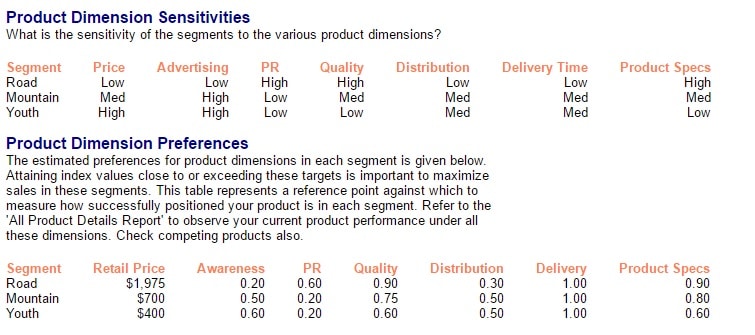
It is crucial that your Product Strategy follow the preferences of your consumers. Valuable Market Research has been conducted to investigate what your customers are looking for in the products they buy. This information is available to you under the Market Information Report (under the Key Reports menu).

Market Information Report with information on Product Dimension Sensitivities and Preferences in MikesBikes Intro

The table above (taken from the Market Information Report) will tell you important areas that you should be focusing on. For example, the Mountain Segment has High sensitivity to Advertising. What this means is you should be focusing your Marketing Budget on Advertising and not PR (as the Mountain segment has low sensitivity in this area). If a market segment is highly sensitive to one area this means: “if you increase this figure, then proportionately more people are going to buy your bike.” This would then result in a higher return on your investment than if you invest in areas where your target market segment has a low sensitivity in.

  1. Incorrect Pricing Strategy

Students make a mistake on pricing their products too high without the increasing demand and their Sales Revenue starts to suffer. Contrary to that, some may also enter into a pricing war and priced their products too low resulting in difficulty covering costs.

When a situation like this arises, you will need to assess where your products are situated in relation to consumer preferences and your competitors. The best report to look at would be the “Market Summary Report” and identify if your product has low Awareness, low Quality or low Delivery (or all of the above) in comparison to your competitors. If they do, you should price your product at the lower end of the market. If not and demand for your product is still average to high, then you can price your products at the higher end of the market. Keep in mind that extreme prices, high or low, will have a negative effect on Gross Margins.

Question #2

In the fourth period, we’ll be given the option to launch a new product and modify our existing product. Is it better to remodel an existing product or launch a new product?

This depends on what your team decides to be more valuable to your strategy.

Essentially, when looking at launching a new product you will need to ask yourself the following questions:

  • How big is the market for this product (Check the Market Information Report)?
  • How many existing competitors are in there?
  • Are we expecting any new entrants into this segment in the upcoming rollover? If so, what do we anticipate their market share would be?
  • How many bikes would we anticipate on selling?
  • Taking into account of the above, how much would we spend on marketing to enter the market?
  • Based on our effective number of sales in the segment, what do we anticipate our profit to be?

You can then compare this potential profit against the potential profit gained from modifying your bike.

In remodeling your existing bike, you will look at things like:

  • Are we remodeling to reduce costs or improve Technical Specifications (or both)?
  • If we want to reduce costs, is the $1 million modification cost outweighed by the profit gained in the reduction costs?

You can calculate it as:

Old Production Costs – New Production Costs x Number of bikes you anticipate you will sell

  • If you want to update the Technical Specifications, look at the Market Information report to see how sensitive the market segment is to changes in that? If it is High, then getting closer to the Ultimate Technical Specifications could result in significant increases in demand for your product (depending on how far away your product is from that desired technical specifications).
  • How do anticipate this impacting our sales?

Once your team has looked at those two things (new bike versus modification) then you can decide, “Okay, which is more valuable to us right now? Can we afford that? Could we afford both? Or neither?” You can then evaluate your Cashflow Report for your Ending Cash Balance from the previous year.

Question #3

What is the best strategy to implement to get the best return in Distribution?

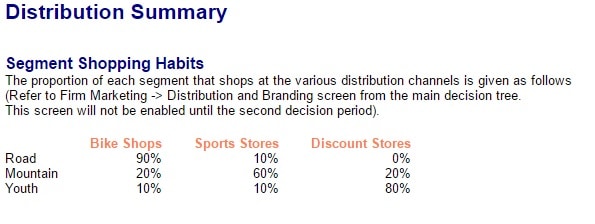
The best strategy is to look at the Distribution Summary report (see the table below for what this might look like) and analyze where your customers shop. Once you have identified this, place more emphasis on your Retailer Margin and Extra Support in those Distribution Channels.

Distribution Summary Report in MikesBikes Intro

It is also important to keep in mind here that the more a distributor profits from selling your products, the more likely they are to stock your product in upcoming years.  That means they consider things like your Price, Sales Volume, Retailer Margin and Extra Support. However, be careful not to eat so much into your own products.

If you have any questions, please feel free to click here and fill out a form or email us at help@smartsims.com.

Engaging Millennials in Business Simulations with Gamification

Gamification: Engaging Millennials in Business Courses through Business Simulations

The term gamification is a relatively recent addition to the scholarly vernacular. In fact, the first documented use of the term doesn’t appear until 2008 (Detering, Dixon, Khaled, & Nacke, 2011). While there have been a number of definitions put forward, most publications agree on a general definition being the use of game elements and design in a non-game setting (Seaborn & Fels, 2015). The broad use of games among members of the millennial generation creates an opportunity for increasing student engagement and motivation in traditionally non-game environments, such as a business school. Given this, educators are increasingly using gamification techniques to increase student engagement (Seaborn & Fels, 2015). These include the use of advanced business simulations. Gamification applied to these kinds of simulations can increase engagement, motivation, targeted learning outcomes, critical thinking skills and cognitive reasoning.

Gamification includes a variety of methods, the most basic of which is the use of game elements to create a gamified experience. Game elements include:

  1. immediate feedback on performance through the use of badges and icons,
  2. leaderboards,
  3. awards,
  4. interaction with other players.

Research indicates that the use of these game elements can result in an increase in engagement and motivation (Thom, Millen, & DiMicco, 2012). Other implementations of gamification, such as business simulations, appear to have longer lasting positive effects on not only participation but more so on desired learning outcomes, especially within an educational setting.

The purpose of educational business simulations, at their core, is to create an experiential learning environment to improve the learning outcomes and student success. Through a gamification lens, business simulations do that. Each of Smartsims’ Business Simulations easily tick off those requirements:

1. Immediate Feedback on Performance through Icons

Smartsims MikesBikes Icons Gamification

The above is a picture of MikesBikes Introduction interface.

2. Leaderboards
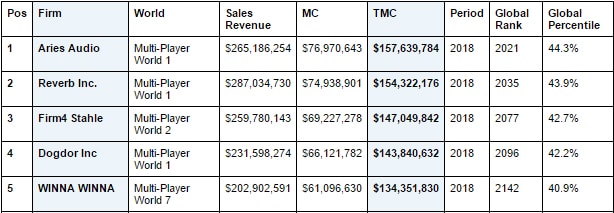
Music2Go Marketing Leaderboard Gamification

The above is a picture of Music2Go’s class specific leaderboard (note we also have a Hall of Fame tracking the performance of teams throughout the world).

3. Awards

Smartsims Business Simulations are strong believers in rewarding excellence. Every year the Smartsims team holds the MikesBikes World Championships to find the ‘best of the best’ and award the winning team. Further, the students who achieve top of their class or enter into the Hall of Fame are given notoriety within our website through an article/interview as well as the Worldwide Leaderboard.

4. Interaction with Other Players
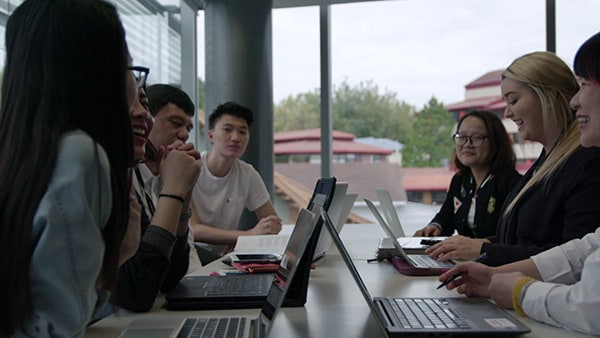
Interaction among students using Mikesbikes

MikesBikes encourage interaction with other plays both directly and indirectly. Often students can form the ‘management team’ of their firm where they interact directly with each other to enter the important decisions of their team. Students will also be competing directly against other teams within their course to achieve the highest Shareholder Value (one of the main KPIs within MikesBikes).

Gamification and Business Simulations

Gamification can be viewed as an instrument within the toolbox of experiential learning, and as such, can be used to enhance desired learning outcomes. These desired learning outcomes include the development of critical thinking skills, increased motivation, and greater cognitive ability (Lovelace, Eggers, & Dyck, 2016). Rousseau (2012) describes the critical thinking process as “involving questioning assumptions, evaluating evidence, and testing the logic of ideas, proposals and courses of actions” (p. 13). An advanced business simulation such as MikesBikes includes rounds of play in which assumptions are drawn, and data is analyzed before decisions are made. The start of each new round gives the student an opportunity to reflect on the outcomes of previous decisions, and use that knowledge to reanalyze data and make new inferences. Ultimately, through the use of simulation students must go through the various stages of critical thinking. Furthermore, they simulate problems that build over time and become more involved as the simulation advances. This increases student knowledge and cognitive reasoning (Collins & Halverson as cited in D.J., Beedle, & Rouse, 2014).

Gamification is a relatively new and continually evolving application and can range in impact. Educational business simulations, such as MikesBikes, can use a variety of gamification techniques to enhance the learning experience, as well as increasing student engagement and motivation. This is particularly important in the modern educational environment and the challenges of engaging the millennial generation. However, the most attractive outcome in the combination of gamification and simulation is the development of critical thinking skills and cognitive reasoning, both of which are very difficult to achieve in a typical learning environment.


References

Cadotte, E. (2016). Creating Value in Marketing and Business Simulations: An Author’s Viewpoint. Journal of Marketing Education , 38 (2), 119-129.

Cheong, C., Filippou, J., & Cheon, F. (2014). Towards the Gamification of Learning: Investigating Student Perceptions of Game Elements. Journal of Information Systems Education , 25 (3), 223 – 244.

D.J., F., Beedle, J., & Rouse, S. (2014). Gamification: A Study of Business Teacher Educators’ Knowledge of, Attitudes Towards and Experiences with the Gamification of Activities in the Classroom. The Journal of Research in Business Education , 56.1, 1-16.

Detering, S., Dixon, D., Khaled, R., & Nacke, L. (2011). From Game Design Elements to Gamefulness: Defining “Gamification”. Proceedings of the 15th international academic MindTrek conference: Envisioning future media environments (pp. 9-15). Tampere: ACM.

Lawley, E. (2012, July – August). Games as an Alternative Lens for Design. Interactions , 18 – 19.

Lovelace, K., Eggers, F., & Dyck, L. (2016). I Do and I Understand: Assessing the Utility of Web-Based Management Simulations to Develop Critical Thinking Skills. Academy of Management Learning and Education , 15 (1), 100-121.

Paharia, R. (2012, July – August). Gamification Means Amplifying Intrinsic Value. Interactions , 17.

Rousseau, D. (2012). Envisioning Evidence-Based Management. Oxford Handbook of Evidence Based Management , 3-24.

Seaborn, K., & Fels, D. (2015). Gamification in Theory and Action: A Survey. International Journal of Human-Computer Studies , 14-31.

Thom, J., Millen, D., & DiMicco, J. (2012). Removing Gamification from an Enterprise SNS. Proceedings of the acm 2012 conference on computer supported cooperative work. , 1067-1070.

MikesBikes World Champs

2016 MikesBikes World Championship Competition Results

The difference between a successful person and others is not a lack of strength, not a lack of will knowledge, but rather a lack of will.”

-Vince Lombardi

Our 2016 MikesBikes World Champions, Helen Wheels from Algonquin College secured the top position, becoming the “Best of the Best” and Bat Wheels from the University of Auckland who came in at a well-deserved second place. These top two teams certainly had the will to succeed and win the competition.

Helen Wheels and Bat Wheels started strong and performed consistently throughout the competition. They consistently adapted to their market, made growth-oriented decisions and remained true to their firm’s mission. Both firms developed and executed excellent business strategies which saw them rise to the top.

Our two winners had the following to say:


First Place: Helen Wheels from Algonquin College

“That was a very aggressive first round by everyone. Even though the ending SHVs may not reflect it, the first few rollovers were challenging. It was fun competing with everyone and putting concepts I learned from school into practice.”

-Joshua Kalman

2016 MWC First Place Holder Joshua Kalman


Second Place: Bat Wheels from the University of Auckland

“I never knew running my own company could be so much fun.  Smartsims has provided us with a great business simulation and I will miss being a part of this competition.”

Mohammad Sami Siddiq

2016 MWC Second Place Holder M Sami

Congratulations to both teams and thank you to everyone who participated! It was another great year full of intense competition.

Here’s the Final Round’s Rollover Results:

Pos Firm SHV School Team Members
1 Helen Wheels $291.13 Algonquin College Joshua Kalman
2 Bat Wheels $119.88 University of Auckland Mohammad Sami Siddiq
3 Dr Sprocket $106.48 University of Auckland Nicholas Goddard | Meng Zhang | Tingyu Fu | Yanxin Jiang | Philipp Noack
4 2 of the 3 Stooges $1.55 Bethany College Josh Hickok | Tanner Wallace
5 Top Air $1.44 Waikato Institute of Technology Qi Zeng | Li Zhang
6 Bonilla Ice $0.01 Santa Clara University Brian Bonilla
7 Holy Spokes Inc $0.01 University of Idaho Zachary Thomas
8 Tortoise Inc $0.01 Drexel University Alexander Kaloudis

You can view the current and past winners here.

Mason (MikesBikes Student) received award from DMACC President

Hall of Fame Award Presented to DMACC Student

On the 6th of January, Robert Denson (President of Des Moines Area Community College) presented Mason G. Ohnemus with a plaque commemorating his amazing achievement making the MikesBikes Hall of Fame.

Mason G. Ohnemus was able to apply theories he learnt in class to his simulated firm to achieve a Shareholder Value of $391.77. In doing so, he has earned himself a position within our 2016/2017 MikesBikes Introduction Hall of Fame! Smartsims would like to congratulate Mason for striving to be the best he possibly can.

In attendance on this proud day was his Instructor (Russell Holmes) and several other satisfied members of the community and staff.

We extend our appreciation and admiration of Russell Holmes who organized the plaque and the award ceremony for Mason. It is very clear that Russell is truly passionate about education and his students’ success.

What a wonderful start to 2017!

Dan Bielinski Madison Area Technical College

MikesBikes in an Introduction to Business Course

Dan Bielinski Madison Area Technical College
The article below is written by Dan Bielinski, business instructor at Madison Area Technical College.

As a relatively new Business Management Instructor (in my third year) after a nearly 30 year career in industry and consulting, I have found MikesBikes Introduction an extremely helpful tool for teaching real-world business concepts. In the spirit of sharing among educators to benefit students, I am privileged to discuss some of the approaches that have worked for me.

We utilize the MikesBikes Single-Player in our Intro to Business Course. Students work in teams and compete against the computer. There are two practices I have found very effective:

1. I cover course material on Strategy, Marketing (the 4 P’s), Operations and Finance, primarily through case studies and other active learning techniques. I then use MikesBikes and help students “connect the dots” and apply these concepts in the simulation.

Both direct student feedback, and the kinds of questions they start to ask, tell me the simulation is taking student understanding to a deeper level. Much like moving toward case studies and away from lectures deepened learning, the simulation took learning provided by the case studies to a deeper level.

2. I have students work in teams of three. Each Team designates a VP-Sales & Marketing, a VP- Operations, and a VP-Finance. Each of their “bonuses” is based 50% on maximizing a specific departmental metric, and 50% on Shareholder Value growth. All three have to agree on all decisions.

The bonuses take the form of hefty extra credit points. For example, the VP-Sales with the best sales growth rate wins extra credit points; similar for the other positions. However, EACH member of the Team with the highest Shareholder Value wins extra credit points.

This simulates the dynamic that happens in actual businesses between Departmental Managers. It gets pretty real— in one case, a student was still yelling at a teammate 20 minutes after the simulation ended—“You hosed us; all you cared about was your Department.”

Last semester, we started using the MikesBikes Multi-Player in our Capstone Leadership Course. Students still work in teams, but now compete directly against each other to maximize shareholder value. The experience exceeded my high expectations. Key learnings we were able to drive home included:

  • The business mindset of always continually looking for an advantage or edge. Since all Teams start out identically, if they all follow similar strategies, no one will stand out. However, since the reports allow you to figure out- and copy, others’ strategies, you must continually look for a new angle.We connect that to running your Department—for example, if you run a Customer Service Team, how can you give your Sales force “something to sell” that your counterparts are not doing. And since your counterparts can probably copy you if it works, are you thinking about the next improvement? Etc.
  • Since all Teams start out with identical positions and decisions to make, and the end results vary wildly, the core source of differences in results is the members of each Team. This leads to a discussion of team makeup— complementary skill sets, depth of understanding of the “business”, ability to work together, etc. It is the most powerful way I have seen to teach the importance of teamwork.This easily transitions into how you build your department’s team— hiring into your weaknesses, knowing that both deep skill sets and ability to be a team player are vital, etc.
  • The simulation allows us to help students develop a broader business perspective, and to drive home the importance of such a perspective. For example, most companies do not want a marketing expert running Marketing; they want a business person who has deep knowledge of marketing. Same for Operations, Finance, and so on. Being able to “see the big picture” and have “your world” be bigger than just your department is vital.

I looked at other simulation packages, and concluded that MikesBikes had an optimal level of complexity. It is not simplistic-all the lessons above can be taught, yet it is not so complex that it takes students a long time to learn. I was able to do a self-paced tutorial of a five year simulation using a screencast (35 minutes total run time), that enabled students to learn the basics on their own outside of class (using the online version of MikesBikes).

The service and support from Smartsims has been absolutely exceptional- and I say this as a former Customer Service VP. I was comfortable recommending to our Dean that we expand our relationship to the Multi-Player only because of the 18 prior months of phenomenal support.

Product Updates for MikesBikes Introduction and MikesBikes Advanced: December 2016

Over this year, we have made several tweaks and improvements to our simulations:

1. Product Summary / Contribution

The Product Summary – Sales, Margin, Production report has been updated in order for students to identify the contribution of each product:

Product Summary Report Screenshot

2. Fines System

Instructors wanting to penalize firms can do so via the Firms menu of their Administrator features:

Fine Firm Screenshot

For students, this amount shows up after the rollover has been processed in the Income Statement:

Income Statement Screenshot

The fine directly impacts the firm’s profit, which feeds into Shareholder Value.


3. Minimum Share Issue Price is now $5 per Share

  • Struggling firms need access to equity.
  • Even bankrupt firms can issue 50% more shares at $5 / share to recapitalize.
  • E.g. A firm with share price of $0.76 and 1 million shares issued could issue 500,000
    shares at $5 / share = $2.5m (making it slightly easier for them to recover).

 4. Up to 20% Share Repurchase

In MikesBikes Introduction

The simulation now allows for students to repurchase shares up to 20% beyond original 1 million share allocation.

Eg. If you have 2 million shares issued, you could repurchase 20%, or 400,000 shares.
When below 1 million, the limit remains at 10%.
Eg. If you have 900,000 shares issued, you could repurchase 90,000 shares.


In MikesBikes Advanced

The simulation now allows for students to repurchase shares up to 20% beyond original 2 million share allocation.

Eg. If you have 3 million shares issued, you could repurchase 20%, or 600,000 shares.
Below 2 million the limit remains at 10%.
Eg. If you have 1.8 million shares issued, you could repurchase 180,000 shares.

5. Limit to Projects/ Products

In MikesBikes Introduction

Firms can sell multiple products in a single market segment. This can work if student plans well. But it is often unintended and market share drops due to product cannibalization.
Instructors can now limit students to having at most one product in each segment. At the beginning of your course please let your account manager know if you would like your course set up in this manner.

In MikesBikes Advanced

We can optionally LIMIT:

  • Max Projects per Period
  • Max Products
  • Max Products per Segment

6. Specific MikesBikes Introduction Scenario Improvements include:

  • Sports segment around 40% larger, meaning firms have more room to expand as well a higher chance of generating larger revenue.
  • Branding is cheaper to attain once Distribution and Branding decisions are available.
  • Efficiency is cheaper to attain once Capacity decisions are available.
  • Road segment more sensitive to Quality and Product Specs.
  • Bankrupt Firm Share Price improves faster.

 7. MikesBikes Advanced will contain IFRS Financial Statements:

International Financial Reporting Standards (IFRS) are common outside North America, therefore to ensure relevancy to all schools these have now been included. The reports have different names and layouts for Financial Statements.
The different names for financial statements can be:

  • Statement of Comprehensive Income
  • Statement of Financial Position
  • Statement of Cash Flows
  • Statement of Changes in Equity
Business Simulations Future Proofing

Future Proofing Your Student’s Skills

How do you future proof your student’s skills and knowledge when nobody can be certain what jobs will be available? To give you an idea; we no longer need the bowling alley pinsetter, human alarm clocks (“Knocker-up“), ice cutterslamplighters, or switchboard operators which technology and economic conditions has so readily replaced today.

A recent study by the World Economic Forum predicts that approximately 5 million jobs will be lost before 2020 as technology replaces the need for human workers. Millions of workers today that don’t account for the possible future where their current job is automated (and prepare accordingly) are likely to find their jobs redundant.

What does the future require of us?

It is not all doom and gloom. Researchers like David Deming (Associate Professor of Education and Economies at Harvard University) argue that soft skills such as sharing and negotiating will be crucial alongside a strong technical understanding of theories and practice that are traditionally taught in current courses. As a part of his research, Deming has mapped the changing needs of employers and in doing so identified the key skills that will be required to thrive in the job market in the future.

graph

Source: David Deming, Harvard University

What do we take away from this? 

Specific roles which relied heavily on one type of skill over another (hard vs soft) are not the way of the future. In recent years, jobs which only required mathematical skills have been automated whereas jobs which rely solely on social skills tend to be poorly paid. To ensure students take solid and future-proof skills from their time at an education institution they need to be taught both hard and soft skills.

How? 

Business simulations provide students with the opportunity to engage and expand their skill set. Not just the hard or the soft but encourage students to combine the two. Recent research has shown that business simulations are effective at developing critical thinking and analytical skills as well as improving a students ability to negotiate, communicate and work within a team. Over the past 20 years various researchers have conducted research into the benefits of business simulations.

There are many forms of this; marketing simulations, business simulations, management accounting simulations, and advertising simulations. If you’d like to learn more about future proofing your student’s skills through business simulations then click here.


Professor Teaching Business Simulators

An Instructor’s Experience: From MikesBikes Critic to True Fan

Written by Russell E. Holmes, a business and law instructor, at Des Moines Area Community College.

It All Began…

A few years back my business department decided to incorporate a business simulation game into our Introduction to Business course. The college felt our introductory business course would become more acceptable as a transfer course to a larger number of universities if we did this.

I was adamantly opposed to requiring a simulation in the course. I had taught the course for many years, was comfortable with the variety of assignments and activities I had developed over the years and had no interest in having to deal with what I perceived to be an activity that would take a lot of time and, in my opinion, be of minimal value.

What really upset me was when I was told we would be required to take students through chapters that dealt with accounting, financial management, securities and marketing at the beginning of the course so they would be able to understand the simulation better. I was beyond angry as I had always done those chapters at the end of the course. More than that, I felt the tail was wagging the dog – in other words, I felt the simulation was becoming the centerpiece of the course as opposed to being a part of it.

Taking A Stand

In protest to this major change to the course, I choose not to teach it. I had enough other courses I could teach that I did not need to do the Introduction to Business course. I felt bad about this as I had always enjoyed the course but, well, I had no interest in dealing with the business simulation and all the problems I was sure it would bring about. I was fairly confident that in a couple of years MikesBikes would become a thing of the past and the people who had advocated for it would see the error of their ways.

Reluctantly Accepting

About two years after the college began requiring the business simulation in all the Introduction to Business courses, I was forced to teach the course again since I needed a full load. I was upset, to put it mildly, that I would have to deal with the simulation. I was convinced it was a waste of time and greatly over-rated. I had ignored it for two years and had had no interest in learning what it was all about.

Still, I had no choice. I figured if the students were going to have to deal with it, then I would figure out a way to make it somewhat palatable. There had to be some redeeming value to it even if I had no idea what it might be. I knew I would need to be able to explain it and have some working knowledge of it for obvious reasons.

Knowing I had no choice I was forced to dive in and begin to learn what this MikesBikes simulation was all about whether I liked it or not (and I definitely did not). Over a long break I attempted to learn how to do the simulation. I would go in spurts. After struggling with the most basic of concepts in Years 1 and 2 (how in the world am I supposed to determine a selling price or how many units to produce?!) I fought and cursed the simulation every step of the way. I was determined to prove it was a waste of time and could not in any way be remotely realistic.

The Turning Point

However, slowly – ever so slowly – I began to see a glimmer of light here and another glimmer there. No matter how hard I tried to find fault with every aspect of the simulation, I began to see something that was slightly interesting and perhaps even somewhat relevant to this thing we call “business.” I began to see the marketing screen and the production screen actually correlated with each other (can you say “supply and demand”?).

I began to realize those Key Reports – something I had tried to ignore – actually had some really valuable information in them and were appropriately named (imagine that?). I discovered that if I knew the size of my market it was actually helpful in determining how many bicycles my factory should be producing in the upcoming year. Slowly, ever so slowly, I stopped cursing the simulation and began to see how it might have some value.

As the simulation progressed into Year 2 and Year 3 and Year 4 an amazing thing happened – what I had learned in earlier years could be used to build upon in the following year. Before long I was seeing a rather interesting relationship before my eyes involving many pieces to a large puzzle – financing, production, advertising, branding, pricing, dividends and on and on. So many pieces but they all fit together so nicely when you – the owner of your firm – figured out how to put those pieces in place.

From Ugly Duckling to Beautiful Swan

The simulation was no longer an ugly, disjointed, confusing maze of frustration. Rather it had turned into a beautiful kaleidoscope of moving parts and beautiful colors. There was no one right way; there were actually many right ways to obtain a high shareholder value. I was, in a word, astounded at not only the beauty of the simulation but the intricacy of it. Still, it was simple enough for a student in an Introduction to Business class to understand if he or she was willing to give it some time and thought.

Isn’t that what a college course is all about – taking the time to give the subject matter some time and thought so the concepts can be digested? Isn’t actually being actively engaged in an ongoing project – something that requires a person to work on week after week – better than sitting passively reading or listening or even watching a video about some topic?

The Value

I, the old curmudgeon, had learned something even though I had tried so hard to keep my mind closed. The simulation brought some real life into the course and made it better (shocking but true). MikesBikes brought to life a variety of concepts that are discussed in the text and allowed students to work together making decisions for the upcoming year.

Both my online as well as my face-to-face classroom students do the simulation and I could not be more pleased. Sure, some students get so frustrated they want to quit – but I tell them the key is to push forward, stay with it, preserve and never give up. When they see the light it is an amazing sight for me and a feeling of true success for them.

Becoming a Strong Advocate

Today, I would not consider teaching Introduction to Business without the MikesBikes business simulation. I have come full circle from vocal nonbeliever to strong advocate. One of my students this past semester scored #2 in the MikesBikes Introduction Hall of Fame.

If he had only declared a dividend he would have easily been #1! To this day I will never understand why he never declared a dividend for his shareholders!! Oh, what could have been!

More importantly is not what could have been but what is. And what MikesBikes is, is invaluable to my course.


Russell Holmes

Russell E. Holmes teaches Business Law and Introduction to Business. He obtained his law degree from Drake Law School in 1989. He has a Master’s degree from Iowa State; a Bachelor’s degree from the University of Iowa and an Associate of Arts degree from North Iowa Area Community College in Mason City.

After graduating from University, he worked with the Federal Land Bank of St. Paul, Minnesota as a loan officer. In 1977 he started teaching full time for the American Institute of Business in Des Moines and also worked for a consulting firm in Des Moines.

Russell first began at Des Moines Area Community College in 1980 and was with the department until 1986. He left DMACC to attend law school. From 1989 until 2004 he was in private practice in Polk and Story counties. For eight years he was the executive director of the Legal Aid Society of Story County. He returned to DMACC in 2004 and has been teaching there ever since.

New Zealand landscape with a question "When is the best time in the simulation to offer dividends?"

Dividends: When is the best time?

New Zealand landscape with a question "When is the best time in the simulation to offer dividends?"


If you were to walk into a computer lab with students playing MikesBikes, one of the questions or topics of interest that will be discussed is ‘Dividends’. Specifically, when is the best time to pay it and is it worth it?

This article, besides showing off the beautiful New Zealand landscape, will allow you to come to your own conclusion by bringing up factors you should be considering.

Within MikesBikes-Introduction, you need to wait a few rounds before you are even presented with the financial decisions but with MikesBikes-Advanced it is available straight away.

To answer this question quickly, there’s not really a ‘best’ time to offer dividends, but often a firm will establish a habit of paying out a certain proportion of the previous period’s earnings as a dividend, while retaining the remainder to invest in increasing the firm’s future earnings. The proportion of earnings retained for investment will depend on the firm’s growth prospects. A mature firm in a mature industry will often return a very high proportion of its earnings as a dividend because there are few growth opportunities. While these are vast generalizations, you need to figure out if distributing dividends is right for your firm. 

The main purpose of issuing dividends within MikesBikes is increasing your firm’s Shareholder Value (in the real world you are providing a return on your Shareholder’s investment in your firm). Before you begin thinking about how much dividends to issue, you NEED to ask yourself the following questions:

  1. Are you Financially Strong?
  2. Is there something else you can do with the profits?

In answering the question “Are you financially strong” review your Cashflow and Income Statements. Look to see how much cash you have at the end of your previous rollover; how much cash do you currently have? Do you have enough for the amount of dividends you are thinking of issuing? How stable is your Income? Might you need that cash for future expenses?

So you have decided that you have some spare cash. You can do quite a lot with that which might yield a higher return on your firm’s Shareholder Value than issuing dividends. While this article won’t go into complete analysis on how to evaluate these different options, we are simply bringing up alternative options for this cash:

  • Investing further in your firm by expanding into new markets
  • Purchasing another company (MikesBikes-Advanced only)
  • Pay off your firm’s debt to lower the interest payments (Note: it is expected that your firm has at least some debt)
  • Ramping up your marketing decisions to take a larger market share

While evaluating these options be sure to think about how Shareholder Value is calculated within MikesBikes. Typically, Shareholder Value is a measure of the current Share Price (which is based upon your firm’s Profitability, Earnings per Share, and the Debt to Equity ratio) plus the value of all past dividends paid, including interest.

If none of these options make sense, then you might decide to return some of these profits to shareholders through a dividends payment.

Be sure to check out our Facebook page and tutorial videos for further assistance on playing the simulation.