Category Archives: News

Don’t Make These Mistakes in the MikesBikes Advanced Business Simulation

“Success does not consist in never making mistakes, but in never making the same one a second time.”

–          George Bernard

Three of the most common mistakes we see MikesBikes Advanced users make are:

  1. Misunderstanding the Importance of Reaching the Right Customers
  2. Failed Development Projects
  3. Excessive Stock on Hand

Mistake#1: Misunderstanding the Importance of Reaching the Right Customers

Not understanding this can be a costly mistake as it often leads to incorrectly assigning your marketing mix. This can have a negative impact on the demand for your products and can also lead to overspending. Meaning your firm’s profitability is at risk!

How do you know if you are spending your marketing budget inefficiently? Follow through this section, it will show you how to efficiently allocate your marketing budget.

There are three aspects to a marketing budget within MikesBikes-Advanced:

  1. Branding
  2. Advertising
  3. PR

Each market segment is sensitive to different dimensions. View the Market Segment Scenario Information report.
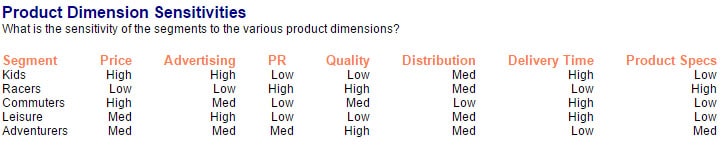
Marketing Dimension Sensitivities

Branding and Advertising work together to improve your firm’s Awareness rating (see Market Summary) whereas your PR index is only influenced by PR spend. Branding promotes your firm’s brands and will influence all of your product’s awareness whereas advertising is product specific.

How do I interpret this Product Dimension Sensitivities graph?
The best way to explain it is through an example. If we take the Racers segment we see it has a low sensitivity to Advertising and a high sensitivity to PR. This means that an increase to our Racers bikes’ PR index (see Market Summary report) is going to have a larger increase to our sales volume than a change to our Awareness rating.

I’ve now chosen which dimensions of marketing I want to focus on, what next?
Branding impacts the awareness of every product you have and is valuable if you have several products within the market. This is a straight forward decision; simply enter in the amount you want to invest into branding.

Whereas Advertising and PR decisions require you to choose media channels based upon the media types’ reach and the media viewing habits of each market segment. There are three media choices to develop your marketing mix on: Television, Internet and Magazines.

There are two substantial sources of information you can use to determine your optimal advertising mix for a given advertising spend.

Each media type can reach a given proportion of its audience for a given investment. This is shown within the Advertising and PR Reach by Media graph below (this can be found within the Market Segment Scenario Information report).
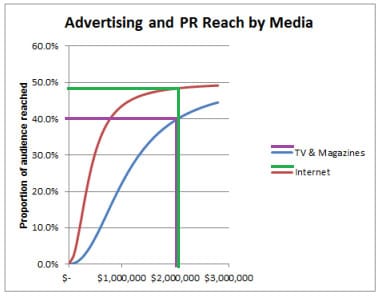
Advertising and PR Reach by Media Graph

The best way to explain this would be to provide an example. A $2 million spent on TV or Magazine advertising (purple line) could reach around 40% of the potential TV or Magazine audience. Whereas $2 million spend on Internet advertising (green line) could reach 49% of potential Internet audience.

However, you also have to consider who uses each media channel. This is where we look at the Media Viewing Habits:
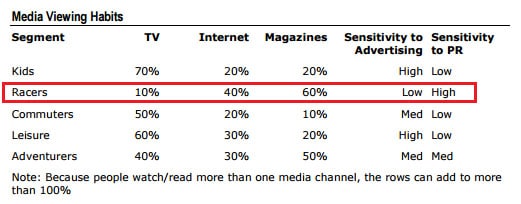
Media Viewing Habits Table

The table shows us that 10% of the Racers market watch TV, 40% engage within the use of the Internet regularly, and 60% read magazines. You use this information with the reach curves to calculate the percentage of the market segment you’re actually reaching.

Okay. I get that, but how do I tell if my MikesBikes-Advanced marketing budget is ineffective?

We have prepared for you two examples. One is a bad example of a marketing spend and the other is a good example. Through these examples this article will walk you through how to calculate an effective spend.

Bad example:

“I have a $2 million budget. I see most people read magazines in the Racers Market and they’re sensitive to PR so I’m going to spend this $2 million on magazines within the Racers market”

 Sound logical, right? No. Far from it.

It is correct that the Racers segment is highly sensitive to PR. It is also correct that 60% of the Racers segment read magazines however it is ignoring the effective reach of each media type. Let’s look at the audience reached and calculate this ‘real reach’ for this bad marketing expenditure:
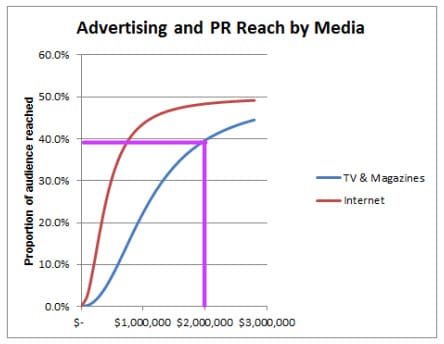
Media reach curve with point in graph pointed out

From the above curve we can see that a $2 million spend on magazines would reach approximately 38%.  60% of the Racers segment read magazines regularly. So our $2 million spend would reach 38% x 60% = 22.8%

So from that example, you might think that it’s best to allocate your budget completely on Magazines, but if we come up with a good Marketing Mix, we might be able to do better.

Good Example:

“I’ve got $2 million to spend on marketing this Racers product directly. I see the Racers market is sensitive to changes in PR so I’m going to fund my marketing budget into PR for this bike. I also see that 60% of this segment view magazines but 40% are on the internet regularly. Also, while racers segment mostly reads magazines; the internet has a higher reach so I will look into investing in both.”

Let’s look at how this logic plays out.
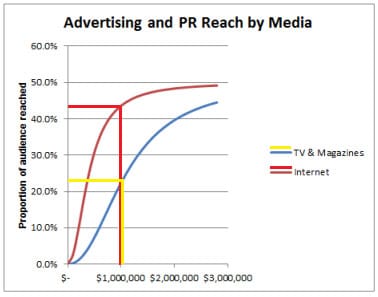
Media Reach Curve Good logic

If we spend $1 million on Internet, we could reach approximately 44% of Internet viewers. 40% of the Racers segment is reachable via Internet advertising, meaning we could reach approximately 40% x 44% = 17.6% of the Racer segment.

Also spending $1 million on Magazines, we could reach approximately 23% of Magazine Viewers. So we could reach approximately 23% x 60% = 13.8% of the Racer segment.

Together, our $2 million budget (half spent on Internet and half on Magazine) would reach approximately 31.4% of the Racer segment. This is clearly a better use of our PR budget than bad example given which only reached 22.8% of the Racers segment.

As you can see, with the same budget, but a different allocation towards each media channel can make a huge difference in the amount of consumers you can reach.

This is only an example of good and bad marketing mixes. This is far from the best mix you can make. We suggest playing around on different Marketing Mix and see what works best for your strategy and budget.

Mistake#2: Failed Product Development Projects

You want to get product development projects right the first time as this can be a costly mistake. It can mean either your Unit Prime Cost is higher than you want and/or your specifications are not as you wanted resulting in a lower demand for your product if they are wrong.

Why did my project development fail and how do I fix it?

Mistake#3: Excessive Closing Inventory

Too much inventory can cause cost your firm in Finished Goods Holding Cost, this can be a needless cost if you are able to predict next year’s demand more accurately.

There are two ways on how you can resolve this:

  1. Start by making Accurate Sales Forecast based on last year’s Actual Sales and adjust production based on this forecast and your current stock levels.
  2. Another step you can take to resolve this is to conduct a Product Modification to extinguish excess stock.

I still need help!

If you have any questions or would like to discuss anything further from what has been mentioned, please feel free to get in touch with us by clicking here.

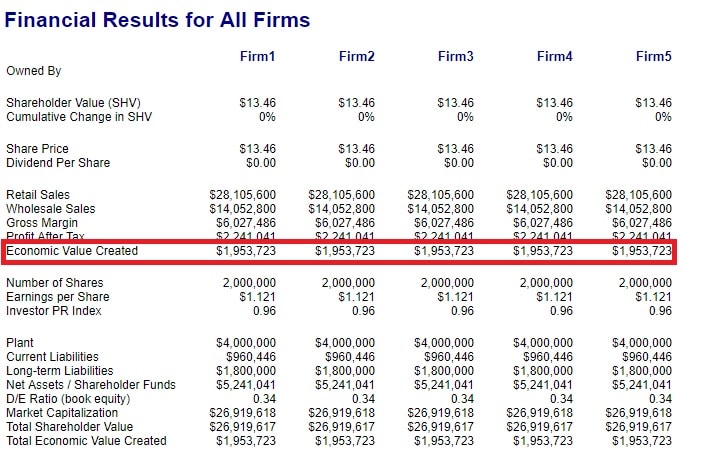
economic value created

What is Economic Value Created (EVA)?

financial results for all firms

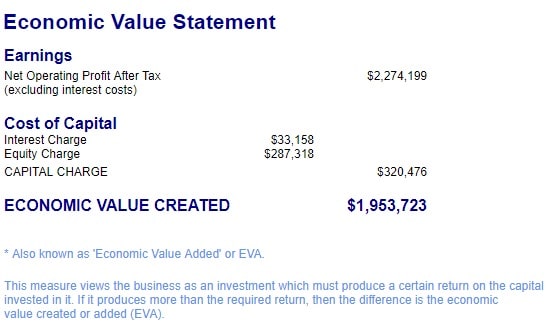
An increasingly popular way of measuring the financial performance of a firm is by looking at the Economic Value Created (often called EVA*) over a specified time span. See the Financial Reports section of the All Reports Menu for the firm’s current Economic Value Created report.

In essence, this measure views the business as an investment which must produce a certain return on the capital invested in it. If it produces more than the required return, then the difference is the economic value created or added (EVA).

The “actual return” is calculated by adjusting the net operating profit after tax to exclude the effects of interest.

The “required return” (or cost of capital) is calculated by adding together the interest charges on debt with the return required by the shareholders. The return required by the shareholders will vary according your firm’s level of risk and will be composed of required dividends and/or increases in share price.

If the actual return is higher than the cost of capital, then the difference is the economic value created. From an economic viewpoint this extra return must be due to some competitive advantage. The question is: How long can this competitive advantage be maintained before competitors come along and copy it?

An example of a simple EVA report is below:

EVA Report in MikesBikes

Notes:

*EVA is a registered Trademark of Stern, Stewart & Co.

different colored bikes

Question of the Week: Can we abandon a recently launched product?

If you accidentally launched a product and wish to abandon this in the same period, you can do so before the rollover.

To do this:

  1. Go to the Products menu. Then click on the Product that you wish to abandon.
  2. On the right-hand menu, click on the Abandon button.

You can launch this product again in a future rollover.

This video will demonstrate how you can abandon your product:

Do you have a question suggestion for our next Question of the Week? Click here to fill out a form or email it through to help@smartsims.com.

Factory to demonstrate Wastage in MikesBikes

Question of the Week: How do we decrease our factory’s Wastage?

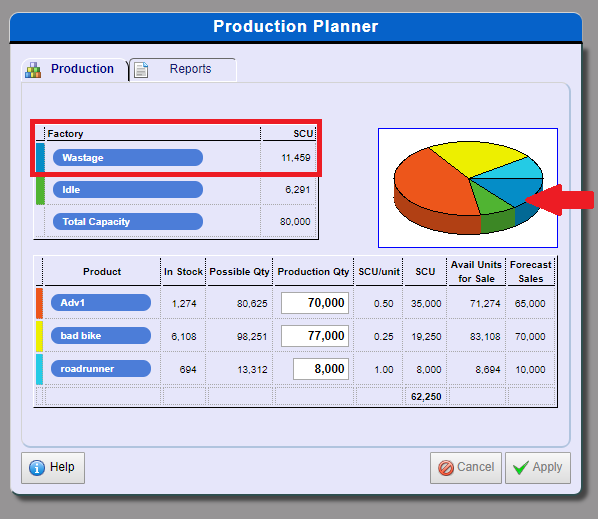
Factory Capacity table and chart in MikesBikes

In MikesBikes Introduction, effective capacity will prove to be less than your plan capacity because of various Wastage factors such as:

  • Rework
  • Setup Time
  • Raw Materials Stockout
  • Machine Downtime

Wastage reduces your factory’s efficiency by using up time that could have been utilized to produce bikes. To improve or decrease Wastage, you will need to spend or economically increase your expenditure on Efficiency.

However, there are trade-offs on this. At a certain point, it can get more expensive to maintain a high factory Efficiency. So you will need to decide if it would be more economical to invest in expanding your factory (which can also be quite expensive and its value also depreciates over time) or you can choose to increase spending in Efficiency, which again gets costly at some point. The key is to find balance in between and see what works best with regards to what your firm is trying to achieve and what you believe to be a worthwhile investment.

As such, there is no “acceptable” percentage of wastage that you should be aiming for, as this is dependent on what your firm believes to be a more economical approach on balancing your factory’s efficiency.

Do you have a question suggestion for our next question of the week? Click here to fill out a form or email it through to help@smartsims.com.

2017 MikesBikes World Champs Winning Team

Interview with the 2017 MikesBikes World Champs Winner: Exodus

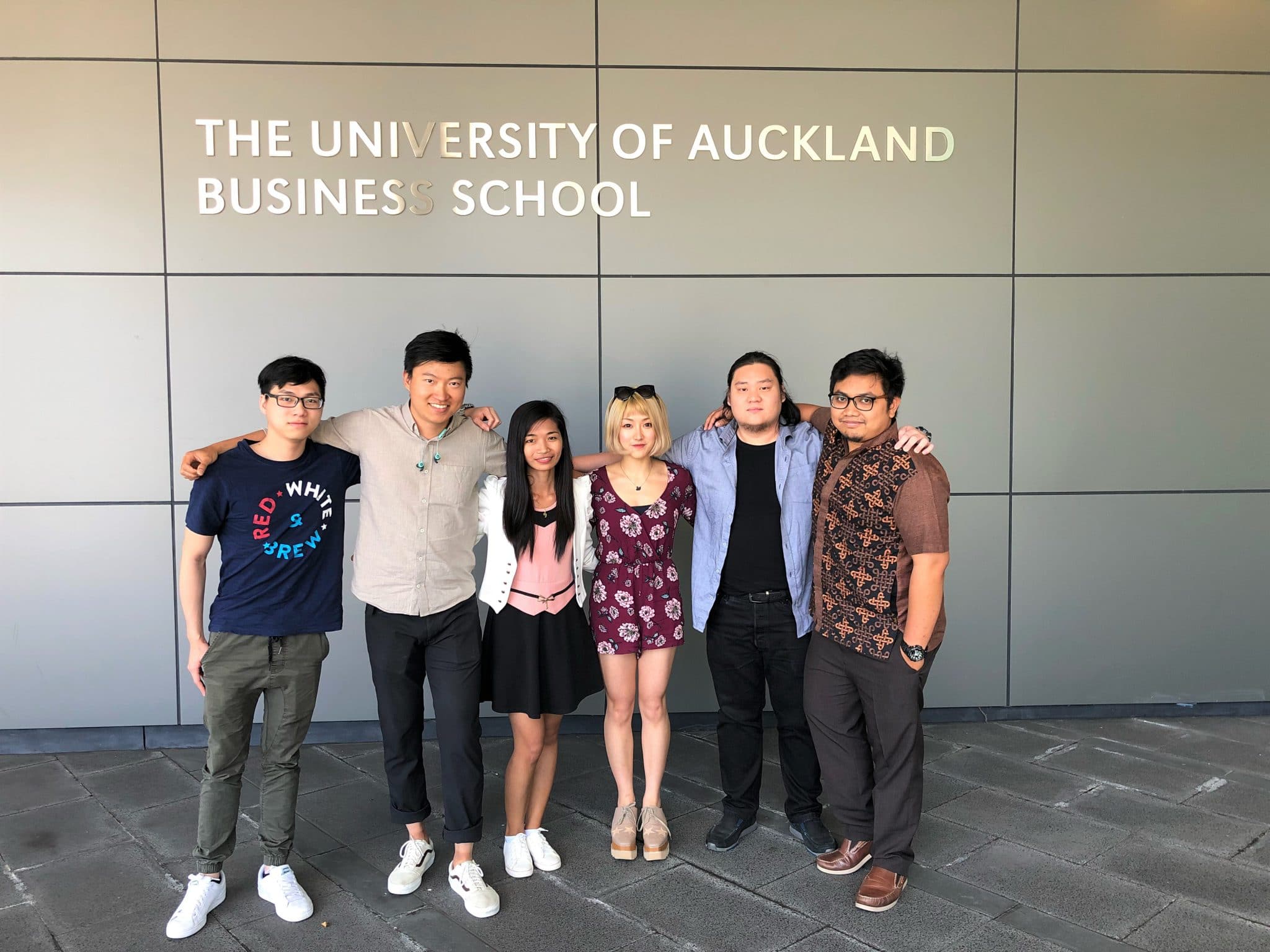
The 2017 MikesBikes World Championship winners Siyi Tang , William Setiawan , Jiedong Chen, Jayca Y. Siddayao, Mingchang Liang and Robbi A. Harnass of Exodus from the University of Auckland have joined the MikesBikes Wall of Champions with their impressive performance in the competition!

Team Exodus competed against the best teams from around the globe and have achieved a Shareholder Value of $327.81.

To wrap up the 2017 MikesBikes World Champs, we have interviewed the team and ask them about their experience in the competition and what they thought about the simulation.

What is your decision making process within the simulation?

First, we analysed the market scenario then we looked at trends in pricing, marketing, financial performance and so on. We then compared these trends with our previous decisions and results.

Finally, we were able to determine whether we would have an offensive or defensive strategy. The most important thing for us is that the final decisions entered have been approved by all team members.

What was your strategy going into the simulation?

Our strategy was focused on developing low prime cost bikes. This strategy did not require a high investment in plant or workforce.

We then focused on our marketing campaign. We developed a marketing mix suitable for our strategy.

Knowing how to calculate the optimum marketing mix, we were able to reach more customers than if we just allocated a high expenditure on every media channel.

Finally, with regards to our financial decisions, we made sure to repurchase shares as soon as we had the additional funds and no profitable use for our extra cash. We were also able to pay out dividends to shareholders.

What challenges did you face? How did you overcome these?

Our competitors undoubtedly did their best to compete. They presented us with fearsome competition during the Championship. Our team also felt that some of the firms just gave up along the way and purposefully destroyed the market by dumping their prices. Pity moves indeed. But then again, it was one of the “unexpected” things that you would not expect to happen, especially during a fierce competition such as this.

Was there anything, in particular, you did that you think helped to prepare yourself?

One of the things that helped us win the world championship was the opportunity to compete with our fellow classmates. In a way, we were used to playing in such a competitive environment, with fearless competitors. However, even with such experience, there were moments during the world championships that we felt very overwhelmed by our competitors’ moves. Thus, once again, kudos to all who fought until the end.

What do you think of the business simulation?

We think MikesBikes simulation is a great way to teach people who want to learn Business Management. It has both practical and theoretical application that gives us real world experience that we would never get from attending traditional lectures and doing written tests.

For example, when we were looking to enter a more competitive market, we were intrigued to find more detailed information. Reports such as the Income Statement, Cash-Flow Statement, Balance Sheet, and Equity Movements Statements were extremely helpful. We made sure to analyze these reports every rollover.

Comments on your experience with the simulation itself

We had a great experience with the simulation. We are glad that we have used this simulation, especially for those of us who have never worked in the industry. By competing in the course competition at the University of Auckland and entering the MikesBikes 2017 World Championship, we learned so many new things, such as:

  • How to allocated our Marketing Expenditure in more attractive media channels
  • How to turn a significant investment in project development into something more profitable in the long run
  • How to calculate the cause and effect of the decision of repurchasing shares and dividends.

Nevertheless, we are honored to be called the winners of MikesBikes 2017 World Championship. There are many decisions that we made, which definitely could be further improved. We hope that newcomers will join the next world competition of MikesBikes, to stand beside us, and the rest of the MikesBikes World Champ Winners.


Check out the 2017 Competition Results here and the previous winners here.

MikesBikes World Champs Smartsims

2017 MikesBikes World Championship Competition Results

“Success is not final, failure is not fatal: it is the courage to continue that counts.” – Winston Churchill

The 2017 MikesBikes World Championship has finished with a bang! Team Exodus from The University of Auckland has secured the top position as 2017’s MikesBikes Champs and have joined the MikesBikes Wall of Champions. Team GOFAST, also from The University of Auckland, came in close second with an impressive performance! These top two teams certainly had the will to succeed and win the competition.

These two teams were neck-and-neck in the last few rounds of the competition battling for first place. Both teams constantly putting pressure on each other to adapt to their market and make growth-orientated decisions.

Our MikesBikes World Champs winning team, Exodus had the following to say:

2017 MikesBikes World Champs Winners
Siyi Tang , William Setiawan , Jiedong Chen, Jayca Y. Siddayao, Mingchang Liang. Robbi A. Harnass of Exodus from The University of Auckland

Our experience with the simulation has been unimaginable. We are glad that we have done the simulation, most especially since none of us have worked in the business industry. By doing the course competition at the University of Auckland, and entering the 2017 MikesBikes World Championship, we learnt so many new things. Such as, how to wisely allocate our marketing budget, how to turn a significant investment in project development into something more profitable in the long run, how to calculate the cause and effect between the decision of repurchasing shares and dividend, and many more. Nevertheless, as much as we are honoured to be called the winner of the 2017 MikesBikes World Championship, let us restate the fact that we are far from perfect. There are many things that we’ve done, which can be further improved. We hope that newcomers will aim to enter the next MikesBikes World Champs and to stand beside us, and the rest of the winners.

A huge congratulations to all the teams who have participated in the 2017 MikesBikes World Champs!

Here are the Final Round’s Rollover Results:

Position
Firm
SHV
Team Members
Institution
1
Exodus $327.81 Siyi Tang | William Setiawan | Jiedong Chen | Jayca Y. Siddayao | Mingchang Liang | Robbi A. Harnass University of Auckland
2
GOFAST $313.41 Harriet Zhang | Golf Tantulaphongse | Xu Wang University of Auckland
3
Infinity $152.80 Sunil Ravindran | Thi Thu Vu | Manfei Cheng | Zhaonan Liu University of Auckland
4
Pedal to the Medal $88.06 Peter Bojsza Drexel University
5
Scooty Puff Legends $86.79 Jamison stewart | Zachary Khan | Nathan Jarrad Linn Benton Community College
6
Square Tires $2.80 Chris Mitchell | Nick Dawson | Darrell Davis Indiana University Southeast
7
Apex Bikes Co. $0.01 Zachary Abel Des Moines Area Community College
8
K2K $0.01 Kimberly Dowe Linn Benton Community College
9
SB Corp. $0.01 Kaushik Shah Midwestern State University
10
Van der Zwan AJ Inc. $0.01 AJ van der Zwan Ithaca College

You can view the current and past winners here.

farming-industry-business-simulations

Business Simulations Help Texas Students Succeed in Farming

Business simulations are helping students all across America succeed in the real world, and this is just as true in “The Lone Star State” of Texas.

Farming is a major industry in Texas, and with technological advancements it has become increasingly important that ranchers and agricultural managers have degrees in business, with concentrations in agriculture, crop science, farm management, agronomy or animal science. Those working in the farming industry need to have a sound understanding of the market, and they need to be able to identify trends, analyze data and maintain their business’ brand.

The booming farming industries in Texas include cattle, cotton, milk and broilers. These are all businesses that produce perishable goods that need to adhere to regulations and laws. They are products that will fluctuate in price depending on the season, consumer demand and competitors, so being business-savvy reduces the risks and helps businesses produce products that are relevant and fit for the current market.

Business Education

One way to obtain a business education is the traditional way, i.e. through rote learning in a lecture hall. A better way to go about studying business is through business simulations, a more modern approach to education that has been proven to help students retain more knowledge and enter jobs with useful real-life experiences. For this reason, many university professors have chosen to incorporate Smartsims business simulations into their courses, such as at the University of Texas – Austin.

Business simulations are designed to make it easier for students to be confidently ready for the workforce as soon as they graduate. There exists a huge opportunity to better equip students with the necessary skills and experience, and business simulations have been tailored to do just that. Active learning through simulated business scenarios allows students to understand business strategy and management concepts at a deeper level.

Why Business Simulations?

The benefits of business simulations are endless. They provide an immersive experience, incorporating a wide variety of teaching methods such as experiential learning, reflective learning, action-oriented learning and the flipped classroom. Students are more likely to be engaged and alert, resulting in better outcomes. Business simulations provide a safe setting for students to bridge theories and concepts with real-life experiences, learning from their mistakes and its consequences as well as celebrating their successes.

Business simulations replicate the informal, reflective and interactive nature of workplace learning. Authors agree that workplace relevant learning is typically created in action as employees form solutions to problems (Gibbons et al., 1994; Marsick & Watkins, 1996; Sternberg & Horvath, 1999). To succeed in a large-scale, highly competitive industry such as farming, workers need to display independent problem-solving abilities. Business simulations help students become more capable.

Smartsims Helps the Farming Industry

We have two business courses designed to help students develop business knowledge and skills, and covert theory into real-world skills. Smartsims’ MikesBikes Introduction is a foundation-level course that allows students to build up their confidence, and MikesBikes Advanced is a highly instructive strategic management simulation that takes it to the next level. The skills learned in these simulations translate well to the farming industry or to any other type of business.

If you are considering entering the farming industry, or you are already in the workforce but want to further your knowledge and skills, contact us to find out more about simulation training. Our business simulation games are changing the shape of the education system, and the success of businesses in Texas and all over the world. Experiential education is the evolution of education.

people looking at computers

New Models Of Corporate Learning – Digital Learning In Business

Adapted from an article written by Karie Willyerd, Alwin Grünwald, Kerry Brown, Bernd Welz, and Polly Traylor and originally published in the Digitalist Magazine by SAP.

“An organization’s ability to learn, and translate that learning into action rapidly, is the ultimate competitive advantage” – Jack Welch

For companies, traditional training methods, such as classrooms, are still relevant, but they are no longer the prime delivery method for learning. Now digital experiential learning methods offer businesses a versatile platform that connects the dots between learning outcomes and business outcomes, such as attrition, employee engagement, and sales growth.

Brown and colleagues of business software solutions company SAP introduce a convincing argument for the effectiveness and efficiency of modern methods of experiential education. Businesses that leverage custom-made, carefully-integrated digital learning models generate effective employees and dynamic business strategies. The authors outline their findings in six exciting concepts.

1. Continuous mobile learning is the future

The future of learning rests with learning methods that are rapid, mobile and on-going. Brown et al. believe the greatest challenge for traditional learning methods is their inability to keep up with the increased diversity and pace of the modern business climate. Systems like classrooms, slides, and textbooks cannot keep up with these pressing factors.

Digital learning allows businesses to mobilize their training systems to each employee in customised, consumable forms. This portable form of learning turns training into a continuous and ever-engaging experience. Bernd Knobel, a director at CGI Consulting called his company’s digital training, “a ‘moment of need’ reference tool” that assists his employees in their everyday duties. As a continuous system, it is a tool that lets employees access it where and when they require. Like CGI, digital learning methods are continuous training systems that give more employees the autonomy to learn as they work.

2. Digital’s Competitive Advantage

Digital learning helps businesses keep up to date with modern developments in technology and communications. Companies like Uber, Netflix, Airbnb and many others used modern technology and digital systems to outrun the developments of tomorrow. Any business can gain this competitive edge by using and understanding the potential of digital learning methods.

3. The Need for Multi-Skilled Employees

Jim Carroll, a renowned business consultant, uses the automotive industry to describe the modern need for multi-skilled employees. Carroll exemplifies how a regular car dealer requires a range of knowledge, “infinitely more complex than it was 5 or 10 years ago.” The integration of complex technology into normal, day-to-day activities necessitates a multi-skilled workforce in any business. Digital learning’s versatile and mobile systems make it the best tool in closing the skills gap of the modern workforce.

4. Motivation the Next Generation’s Workforce

The authors cite that in less than a decade 75% of the workforce will comprise of Millennials eager for expedient and diverse learning. Digital learning is a necessary addition to common business practice should the businesses of tomorrow want an engaged and prepared workforce. The Oxford Economic Workforce 2020 survey suggests that the top concern of employees surveyed is becoming obsolete. Digital learning benefits both businesses and their employees in addressing that reality of obsolescence.

5. The Defining Characteristics of Digital Learning

The article identifies six key characteristics that exemplify the transition from traditional to digital learning methods. The first is micro-learning, breaking large concepts into smaller consumable pieces. Businesses have the freedom to deconstruct their training into whatever sequence or series is appropriate. The main principle is taking large complex ideas and breaking them into smaller, simpler parts.

The second is self-serve learning. An overarching theme of the article is the importance of mobile, accessible learning systems. Digital learning can be cloud-based, updated in real-time and accessed where and when an employee needs. This is just one exciting foundation of its self-serve learning method.

The third is learning as a form of entertainment. Digital learning’s ability to take the form of business simulations, gamified goal-setting or virtual reality makes it an emotive and entertaining learning style. Joe Carella of the University of Arizona shared his praises of digital learning methods describing them as, “more immersive” than traditional online methods.

The fourth is the social learning of digital learning methods. Learning is an “emotional experience and most people don’t want to be alone when they learn”, says Brown et al. The potential for social collaboration produces new avenues for learning strategies and internal business growth.

The fifth, building off social learning, is user-generated content. Founder of The MASIE Centre, Elliott Masie described “raw, user-created content” as having a higher demand above “polished corporate-created content.” Digital learning leverages this social trend allowing employees to learn from each other in a collaborative environment.

Finally, the sixth characteristic is video. Video content can now be created, edited and consumed by anyone with access to a digital device and the internet. VP Cushing Anderson of the firm IDC says “[digital] learning is often about substituting convenience for perfect quality”.

6. The Human Equation of Shifting to Digital

The article concludes by emphasizing the importance of having a strong human connection throughout the digital learning experience. The point is succinctly summarised by the authors, “excellent learning depends on excellent instructors.” Blending digital into traditional, formal modes of learning leverages its human connection to produce knowledge that sticks.

The Main Takeaway

The key premise of the article is that business that leverage personalized, carefully-integrated digital learning models generate effective employees and dynamic business strategies. Digital learning methods are continuous learning platforms that give businesses a competitive edge while fostering a collaborative culture. Nevertheless, its benefits and advantages all rely on the human element and intending businesses should endeavor to integrate digital learning into existing formal training methods.

Smartsims Logo

Meet Smartsims’ CEO: Dennis Gain

This month, Smartsims’ president and CEO, Dennis Gain is featured in Boston Voyager.

Get to know Dennis and Smartsims

Smartsims began expanding its business simulation offerings into education markets throughout the world through partnering with publishers such as McGraw-Hill and Cengage Learning. Its products are now prevalent in universities, colleges, and high schools and in corporate training programs throughout North America, Canada, Australia, Europe, Asia, the Middle-East and New Zealand. In support of this worldwide venture, Smartsims features two offices (one in Boston and one in New Zealand) with a partner in India, to provide around the clock support with their degree qualified staff. Today, Smartsims is dedicated to providing valuable resources for Professors and Instructors seeking to improve student engagement, motivation, and experiential learning through its business simulations. Smartsims have developed a family of online business simulations designed to support a wide variety of courses ranging from Introduction to Business, Strategic Management, Advertising and Marketing simulations.

Dennis Gain, Smartsims CEO
Dennis Gain, President and CEO of Smartsims

Dennis founded and established Smartsims International Limited in 2002 from technology conceived by Dr. Pete Mazany from his Ph.D. thesis at Yale University, New Haven CT, USA. The core of Smartsims today is an online business simulation platform used mainly by university and college students studying business, management, marketing, advertising, accounting and financial management and in corporate training programs. It is used in place of what used to be paper-based case studies in these courses.

Our simulations provide a setting for students to bridge theories and concepts taught in class with real-life experiences. Within this environment, students are engaged with running their own simulated firm, making all key strategic decisions for every aspect of business and competing against others within their course. Competing either individually or in teams, students find business simulations an engaging, realistic and memorable learning experience.

Has it been an easy path overall and if not, what were the challenges you’ve had to overcome?

The journey forward through all of these startup ventures has not been straightforward with a great deal of personal sacrifice and hard work. What has been encouraging is the commitment of key staff at critical times.

For the Smartsims Business Simulations business earlier going was fraught with significant cost over-run in the development of the Online Platform as the internet and online browser technology was in itself emerging. Additionally, earlier marketing releases were with CDs, which quickly became outdated cause large quantities of returns. These occurrences resulted in the need for significant additional funding and delays in releases of products.

Do you look back particularly fondly on any memories from childhood?

Dreaming of becoming a successful engineer. This is what I initially graduated in … a metallurgical engineer. I quickly turned to business, graduating in finance & economics which led to various roles in international business development

Read the full interview here.

Adapted from an article written and originally published by Boston Voyager.

MikesBikes Intro #1 Hall of Fame Entrant from Virginia Commonwealth University

“Funday Bike Parade” Share Their Journey to First Place

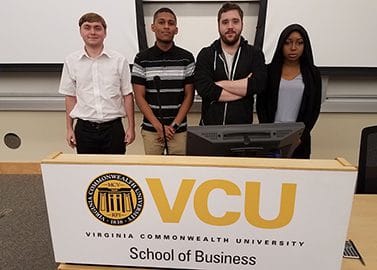
We have interviewed Baird Connor, Daughtey Benjamin, Goodwin Declan, Pearson Sean and Westry Najiyah of Funday Bike Parade (pictured above) from Virginia Commonwealth University who landed the Number 1 spot in the Top 20 MikesBikes Intro Hall of Fame

In this interview, the team provides insight into their strategy, the tools they used to help develop their winning strategy and what they think of the simulation.

What is your decision making process within the simulation? 

The decision-making process begins with checking the situation in the market. If you’re behind, the rest of the production and advertising decisions work mostly in response to other firms’ actions; if you’re ahead of the game, however, you have a lot more freedom to focus on nothing but maximizing income. Generally, we usually consider new products and developments, then possible changes to capacity and production, then possible changes to advertising, then financing and equity options.

What was your strategy going into the simulation?

The strategy from the very start was to try to dominate every market as soon as possible, to suck the competition dry and reach for a high SHV.

How did you begin implementing that strategy?

Astronomically high advertising budgets (or PR, in the case of road bikes) from the start, every time, targeted toward the most efficient audiences. Penetration pricing to help steal even more sales from the competition. New products as soon as possible, every time, to try to dominate the newer markets quickly. For example, when they became available, we immediately jumped at road bikes; our share in that market never fell below 80%.

How did you familiarize yourself with the simulation?

We played with the single player version for a few hours, trying out different strategies and generally discovering how the game worked and how each variable interacted with the others. We would even try rollovers with only one or two variables changed in order to find out the most optimal choices.

How would you describe the competition?

I believe that the competition did not take the same initiative in familiarizing themselves with the game, and so they were blindsided by their lack of market share after the first rollover. After one or two more rollovers, the market had shifted too much in our favor for them to recover very effectively.

What resources did you pull on to develop your winning strategy which led you to be a part of the MikesBikes Introduction Hall of Fame?

We used information from the guides and internet, along with all of the market information given in the simulation (for example, advertising effectiveness and bike-specific preferences). We also used the rough numbers from the first couple weeks to come to the decision that domination on all fronts is the best strategy.

What challenges did you face? How did you overcome these?

Decisions were difficult in the early stages because everyone started off on even footing, and each new decision option was mostly mysterious at the start. However, with experience, practice rollovers, deep experimentation, and dedication, we isolated the variables and won.

Was there anything in particular you did that you think helped to prepare yourself?

Offline rollovers are any player’s best friend, at any stage of the game.

How has participating within a course which uses a business simulation to supplement their teaching materials helped you? What do you think of the business simulation?

It gave a lot more context to the lessons, making them easier and more intuitive to understand. Often, lectures would include references to the current events in MikesBikes, which made them more engaging.

Comments on your experience with the simulation itself

Playing the simulation was a great, useful experience because it gave us the opportunity to look at the basics of the simulation and deconstruct the game in a classroom/team setting. Of all the things that we’ve had to pay for in each class, this was probably the most worthwhile expense.